6 Ways the Library of Congress Online Collections Can Help Your Genealogy
*This post may have affiliate links, which means I may receive commissions if you choose to purchase through links I provide (at no extra cost to you). All opinions remain my own.

You probably know that The Library of Congress (LOC) is the largest library in the world. Its collection has millions of books, photos, maps, newspapers, recordings, and manuscripts.
But here’s what many family historians don’t realize.
Tucked inside those millions of items are rich and free genealogy resources available through the Library of Congress online collections.
If we haven’t met yet, I’m Jessica, the professional genealogist behind Heritage Discovered. With over 20 years of personal research experience and 5 years working with clients. And when I am digging into research questions, the Library of Congress digital collections are often one of the first places I check.
Now let’s look at how the Library of Congress online collections can strengthen your genealogy research.
Related post: How to use the Online Archive of California in Your Genealogy Research

Why the Library of Congress Online Collections Matter
The Library of Congress archives has one of the largest genealogical collections in the United States. There are over 50,000 published genealogies and 100,000 local histories. Strengths include North American research, German genealogy, British Isles resources, and heraldry.
And that is just the beginning.
Alongside those genealogies and local history books, the Library of Congress digital collections include maps, manuscripts, photographs, newspapers, and research guides.
If you’re wondering if the Library of Congress is good for genealogy, the answer is yes. You just need to know where to look.
Let’s break it down.

Currier & Ives. Family Register. New York: Published by Currier & Ives. Photograph. Retrieved from the Library of Congress.
Related post: 11 Great Websites for Free Ship Passenger Lists
1. Chronicling America Historic Newspapers
One of the most powerful parts of the Library of Congress online collections is Chronicling America. This free digital newspaper collection covers 1777 to 1963.
You can search for your ancestor’s name. You can search by town. You can search by topic.
Newspapers can reveal:
Obituaries
Marriage announcements
Birth notices
Court cases
Social columns
Business advertisements
Sometimes a simple search turns up a tiny detail that changes everything.
If you want help analyzing what you find in newspapers, my Newspaper Nuggets worksheet walks you step by step through pulling out every clue the first time you read an article.
2. Published Genealogies and Local Histories
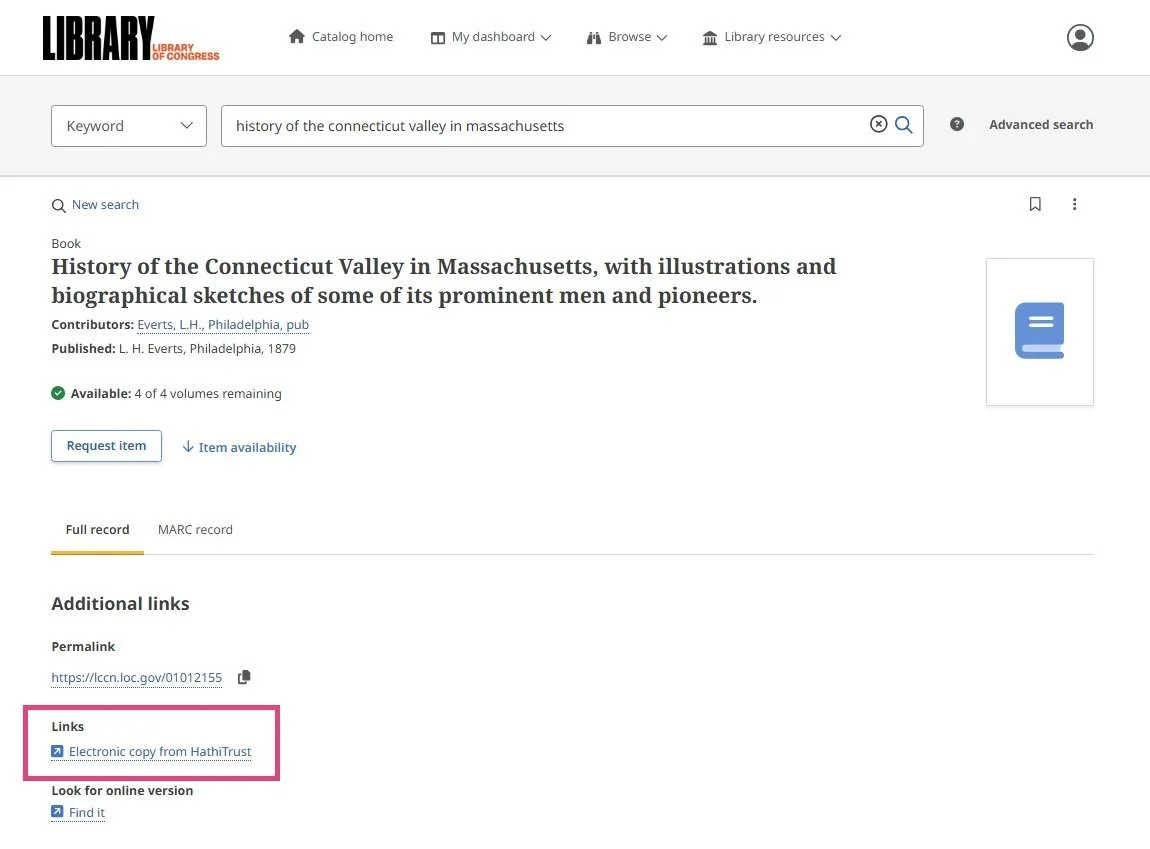
The Library of Congress catalog online includes thousands of family histories and local history books.
When using the Library of Congress online cataloging system, try searching by:
Family surname
Town or county
Combined search like “Smith family” AND Vermont
Even if a book is not fully digitized inside the Library of Congress digital collections, the catalog record often tells you where else you can find it online.
Sometimes you will discover that someone already published a genealogy on your family. Now, always verify that information. But it can give you a starting point.
Local history books are especially valuable. They provide context, migration patterns, and sometimes even biographical sketches.
If you want to understand why local history matters so much, read Why Local History Books Are More Important Than You Think For Genealogy.
3. Maps Inside the Digital Collections
There are many digitized map collections at the LOC. A couple of standouts for genealogy are
Maps from outside the United States
Sanborn maps can show you what your ancestor’s neighborhood looked like. You can see nearby businesses, churches, and street names.
Land ownership maps can help you identify neighbors. And neighbors often turn out to be relatives or in laws.
I once located my 3x great grandmother’s house in Ludlow, Massachusetts, using a land ownership map from the Library of Congress archives. Seeing her name on that map made her feel real.
For more ideas on using maps, read How To Use Historical Maps To Better Bring Your Family Stories To Life and 10 Reasons Why Using Land Ownership Maps Adds Value To Your Research.
4. Manuscripts and Organizational Records
The Library of Congress digital collections also include manuscripts and organizational records.
This might include:
Family papers
Business records
Organizational archives
Movement papers
If your ancestor worked for a major company, there could be employment records. If a female ancestor participated in the suffrage movement, there may be related collections.
Even if your family is not directly mentioned, these materials help you understand the world your ancestor lived in.
And context matters.
Understanding the community, political movements, or economic conditions of the time often explains why families moved or changed occupations.
5. Historic Photographs
The photography collections inside the Library of Congress online collections are incredible.
There are images of:
Immigrant communities
Rural life
Industrial work
Japanese American internment at Manzanar
Urban neighborhoods
Even if you don’t find your ancestor in a photo, you can see what daily life looked like.
And that helps you tell better stories.
If preserving photos is important to you, you may enjoy The Best Way To Store Old Photographs and my Letters From The Past guide for protecting family papers.
6. Research Guides and Bibliographies
Another overlooked section of the Library of Congress digital collections is their research guides.
There are guides on:
Danish immigration
French genealogy
Female ancestors
Civil War diaries
African American genealogy
African American Genealogy Resources includes links to military records and slave narratives.
These guides often point you to resources beyond the Library of Congress archives. They can help you discover collections you did not know existed.
If you are building a research plan, my Locality Research Navigator pairs beautifully with these guides. It helps you organize resources for a specific town or region so you don’t miss anything.

What About Materials Not Digitized?
While the Library of Congress online collections are powerful, many materials are not digitized.
The Library of Congress archives include thousands of items only available onsite.
They also provide access to subscription databases like HeritageQuest and ProQuest Historical Newspapers while onsite.
Although you cannot check books out, many genealogies have been microfilmed and may be available through interlibrary loan. The Library of Congress can also provide photocopies for a fee.
This is where strategy becomes important.
Related post: Why You Should Use Libraries and Archives

Family record of blank / Chapman Bros. Lith. Chicago. Chicago: Chapman Bros., Apr. 20. Photograph. Retrieved from the Library of Congress, <www.loc.gov/item/2012647362/>.
How To Search the Library of Congress Catalog Online
The Library of Congress catalog online is fully searchable.
You can search:
By family name
By place
By topic like Sanborn maps
By combining family name and location
You can also browse by subject, call number, or author.
When using the Library of Congress online cataloging system, try Boolean operators like quotation marks, AND, and OR.
For example:
“Passenger lists” AND Pennsylvania
There is also an advanced search option that lets you narrow by format, subject, and date.
The digital collections section is separate and allows filtering by division and format.
If you like learning how to search effectively, you might also enjoy 6 Google Search Tips For Genealogy.
Related post: How to Use the Digital Public Library of America for Genealogy

Final thoughts on The Library of Congress Online Collections
The Library of Congress online collections are one of the most underused free genealogy resources available.
Between the Library of Congress digital collections, the Library of Congress catalog online, and the broader Library of Congress archives, there is an incredible amount waiting to be explored.
If you feel unsure where to begin or overwhelmed by options, you don’t have to try to tackle it alone.
You can browse my shop for tools to help organize your discoveries, hire me to help you research, or schedule a free 20 minute consultation and let’s talk through your research questions together.